How to Detect Invalid Traffic in Google Ads
Unusual clicks do not always mean fraud. Learn how to review Google Ads traffic patterns, identify suspicious activity, and investigate potential invalid traffic.
October 26, 2026
·ClicksArmor
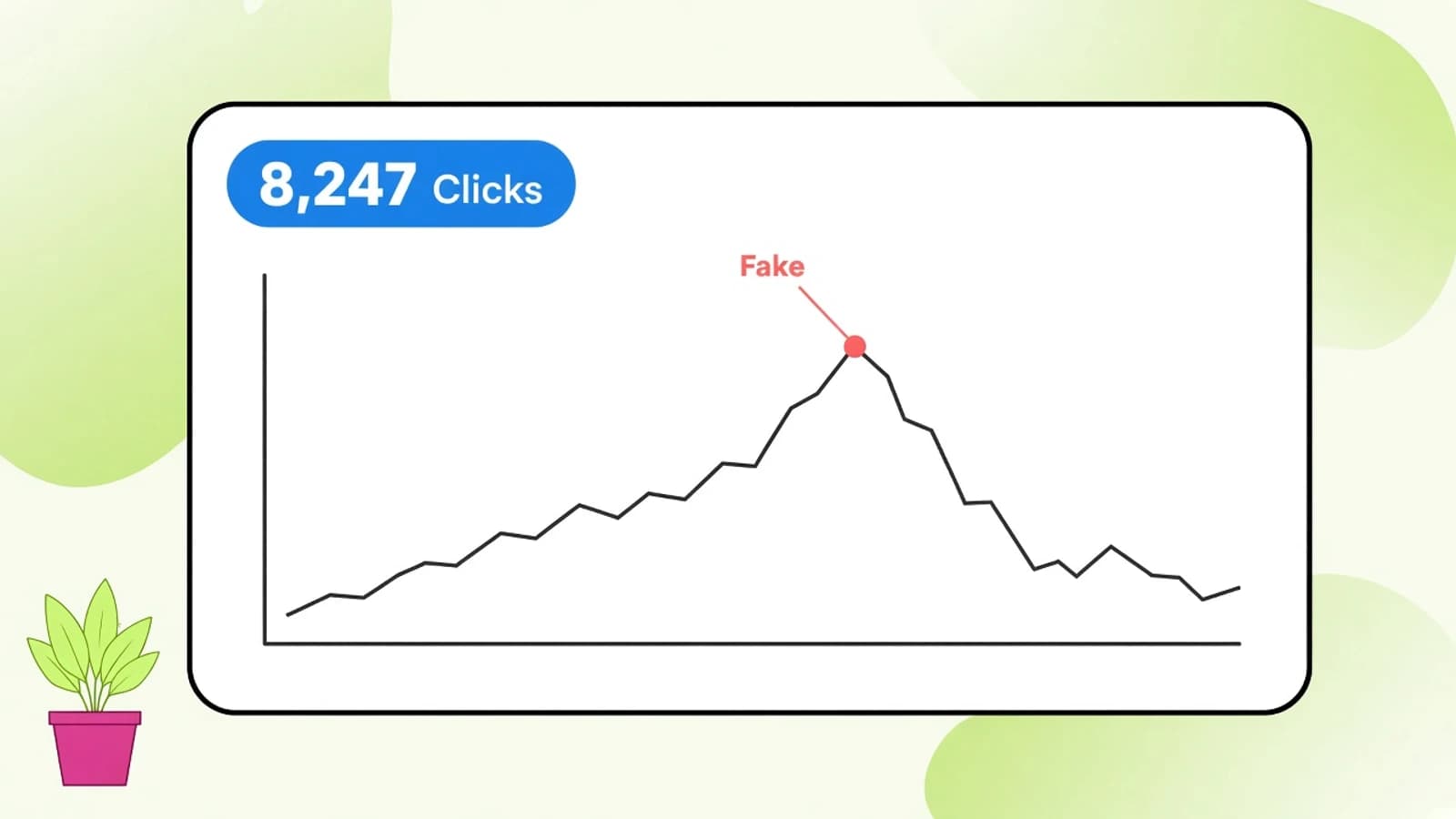
Google Ads already filters some invalid clicks and may issue credits. That does not mean every suspicious pattern is gone - or that every spike is fraud. The useful skill is investigation: separating tracking issues, ordinary low quality, and traffic that deserves a closer look.
This article outlines a measured workflow for Google Ads advertisers. It does not claim access to Google's internal invalid-click systems.
What Does Invalid Traffic Mean in Google Ads?
In Google Ads discussions, invalid traffic usually covers:
- Clicks Google classifies as invalid (and may credit)
- Automated or non-human activity that still reaches your account
- Repeated clicking patterns that look abusive
- Accidental or otherwise low-quality activity that wastes spend
Invalid traffic is not the same as poor conversion performance. A campaign can convert poorly because of offer, creative, landing page, or audience fit - with entirely human traffic.
For definitions that separate click fraud from broader IVT language, see what click fraud is.
Review Click and Campaign Patterns
Start with patterns you can see in Google Ads reporting:
- Sudden click volume changes without matching spend strategy or seasonality
- CTR anomalies on specific campaigns, ad groups, or keywords
- Differences between Search, Display, Demand Gen, and Performance Max
- Short bursts of activity that do not match business hours or promotion calendars
- Changes that arrive without creative, bid, or targeting edits
Compare against your baseline. A "high" CTR in one niche may be normal in another.
Analyze Geographic and Network Signals
Where data is available, look for:
- Geographic concentration far from your targeting or customers
- Repeated IP activity (when you have a monitoring path that surfaces it)
- Network patterns that cluster suspiciously
- VPN and proxy indicators
Important caveat: shared offices, universities, mobile carriers, and privacy tools also produce VPN/proxy or repeated-network signals from legitimate users. Network risk is a signal to combine with behavior - not a standalone verdict. Deeper context: VPN and proxy traffic in PPC.
Look Beyond Click Volume
Clicks alone are a weak story. Where tracking is implemented:
- Landing-page engagement (bounces, time, pages)
- Conversion events and assisted paths
- Differences between ad clicks and website sessions
If clicks rise while sessions stay flat, verify tagging before assuming fraud. Misconfigured GTM or missing landing-page tags create false gaps.
Review Google Ads Invalid Traffic Information
Google publishes guidance on invalid traffic and may adjust billing for clicks it determines invalid. That process is Google's, based on signals advertisers do not fully see.
Third-party monitoring tools observe your traffic and campaign context, then help you review patterns and apply supported exclusions (such as IP exclusions where Google allows them). They complement platform filtering; they do not replace it or expose Google's internal detectors.
What Advertisers Can Do
A practical sequence:
- Review campaign and keyword-level data for anomalies
- Investigate suspicious sources with geographic, network, and engagement context
- Use Google Ads reporting and any available invalid-click information
- Apply supported IP exclusions where evidence justifies them
- Monitor performance after exclusions; whitelist or reverse if real customers were affected
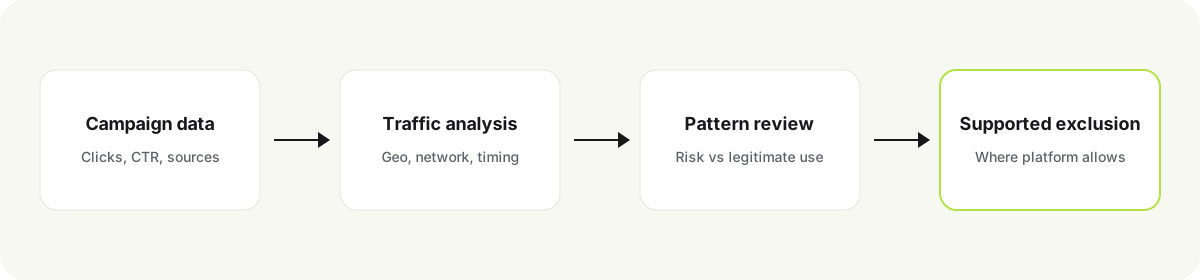 Campaign data to traffic analysis to pattern review to supported exclusion
ClicksArmor's Google-oriented coverage and exclusion approach is described on Integrations. For budget impact framing, see how click fraud can affect PPC performance.
Common Mistakes When Investigating Invalid Traffic
- Treating every high-CTR source as fraud
- Blocking all VPN users by default
- Ignoring broken conversion tracking
- Making broad exclusions from a single day's data
- Expecting exclusions to produce a fixed ROAS lift
Conclusion
Detecting invalid traffic in Google Ads is a review process, not a single switch. Combine campaign patterns, engagement, and network context; respect platform limits; and change exclusions only when evidence supports the tradeoff. That keeps investigation useful instead of reactive.
Related articles


Learn how ClicksArmor approaches detection and supported exclusions across platforms.